All products recommended by Engadget are selected by our editorial team, independent of our parent company. Some of our stories include affiliate links. If you buy something through one of these links, we may earn an affiliate commission. All prices are correct at the time of publishing. Just five years ago, Nintendo was at a crossroads. The Wii U was languishing well in third place in the console wars and, after considerable pressure, the company was making its first tentative steps into mobile gaming with Miitomo and Super Mario Run. Fast-forward to today: The Switch is likely on the way to becoming the company’s best-selling “home console” ever, and seven Switch games have outsold the Wii U console. Everything’s coming up Nintendo, then, thanks to the Switch’s unique hybrid format and an ever-growing game library with uncharacteristically strong third-party support. However, the Switch's online store isn't the easiest to navigate, so this guide aims to help the uninitiated start their journey on the right foot. These are the games you should own — for now. We regularly revise and add to the list as appropriate. Oh, and if you've got a Switch Lite, don't worry: Every game on the list is fully supported by the portable-only console. Animal Crossing: New Horizons
Nintendo
Animal Crossing: New Horizons is the best game in the series yet. It streamlines many of the clunky aspects from earlier games and gives players plenty of motivation to keep shaping their island community. As you'd expect, it also looks better than any previous entry, giving you even more motivation to fill up your virtual home and closet. The sound design reaches ASMR levels of brain-tingling comfort. And yes, it certainly helps that New Horizons is an incredibly soothing escape from reality when we're all stuck at home in the midst of a global pandemic. Buy Animal Crossing: New Horizons at Amazon - $60 Astral Chain
Nintendo
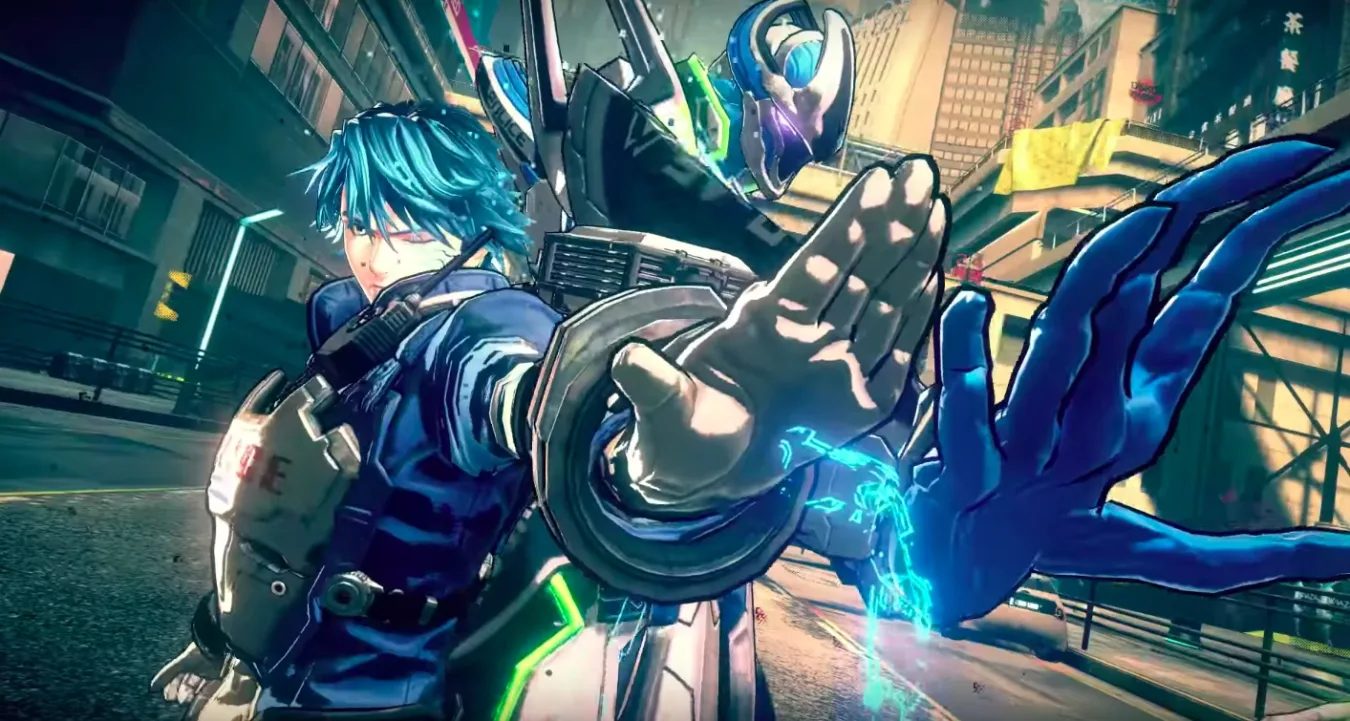
I was on the fence about Astral Chain from the day the first trailer came out until a good few hours into my playthrough. It all felt a little too generic, almost a paint-by-numbers rendition of an action game. I needn't have been so worried, as it's one of the more original titles to come from PlatinumGames, the developer behind the Bayonetta series, in recent years. In a future where the world is under constant attack from creatures that exist on another plane of existence, you play as an officer in a special force that deals with this threat. The game's gimmick is that you can tame these creatures to become Legions that you use in combat. Encounters play out with you controlling both your character and the Legion simultaneously to deal with waves of mobs and larger, more challenging enemies. As well as for combat, you'll use your Legion(s) to solve crimes and traverse environments. Astral Chain sticks closely to a loop of detective work, platforming puzzles and combat — a little too closely, if I'm being critical — with the game split into cases that serve as chapters. The story starts off well enough but quickly devolves into a mashup of various anime tropes, including twists and arcs ripped straight from some very famous shows and films. However, the minute-to-minute gameplay is enough to keep you engaged through the 20-hour or so main campaign and into the fairly significant end-game content. Does Astral Chain reach the heights of Nier: Automata? No, not at all, but its combat and environments can often surpass that game, which all-told is probably my favorite of this generation. Often available for under $50 these days, it's well worth your time. Buy Astral Chain at Amazon - $60 Celeste
MattMakesGames Inc.
Celeste is a lot of things. It's a great platformer, but it's also a puzzle game. It's extremely punishing, but it's also very accessible. It puts gameplay above everything, but it has a great story. It's a beautiful, moving and memorable contradiction of a game, created by MattMakesGames, the indie studio behind the excellent Towerfall. So, Celeste is worth picking up no matter what platform you own, but its room-based levels and clear 2D artwork make it a fantastic game to play on the Switch when on the go. Buy Celeste at Amazon - $20 Dragon Quest XI S: Echoes of an Elusive Age
Square Enix
Dragon Quest XI is an unashamedly traditional Japanese role-playing game. Most of the characters are established RPG tropes: mute protagonist-who’s-actually-a-legendary-hero, sister mages, mysterious rogue and the rest. Then there’s the battle system, which has rarely changed in the decades of the series. (There’s a reason that this special edition features a 16-bit styled version of the game: The mechanics and story work just as well in more... graphically constrained surroundings.) While the story hits a lot of familiar RPG beats, everything takes an interesting turn later on. And through it, the game demands completion. RPGs require compelling stories, and this has one. It just doesn’t quite kick in until later. This eleventh iteration of the series also serves as a celebration of all things Dragon Quest. Without getting too deep into the story, the game heavily references the first game, taking place in the same narrative universe, just hundreds of years later. The Switch edition doesn’t offer the most polished take on the game — it’s available on rival consoles — but the characters, designed by Akira Toriyama of Dragon Ball fame, move around fluidly, in plenty of detail despite the limits of the hybrid console. And while it’s hard to explain, There’s also something just plain right about playing a traditional JRPG on a Nintendo console. Buy Dragon Quest XI S at Amazon - $55 Fire Emblem: Three Houses
Nintendo
Fire Emblem: Three Houses is one hell of a game. Developer Intelligent Systems made a lot of tweaks to its formula for the series' first outing on the Nintendo Switch, and the result of those changes is a game that marries Fire Emblem's dual personalities in a meaningful and satisfying way. You'll spend half your time as a master tactician, commanding troops around varied and enjoyable battlefields. The other half? You'll be teaching students and building relationships as a professor at the finest school in the land. Buy Fire Emblem: Three Houses at Amazon - $60 Hades
Supergiant Games
Hades was the first early access title to ever make our best PC game list, and the final game is a perfect fit for Nintendo’s Switch. It's an action-RPG developed by the team behind Bastion, Transistor and Pyre. You play Zagreus, son of Hades, who's having a little spat with his dad, and wants to escape from the underworld. To do so, Zagreus has to fight his way through the various levels of the underworld and up to the surface. Along the way, you’ll pick up “boons” from a wide range of ancient deities like Zeus, Ares and Aphrodite, which stack additional effects on your various attacks. Each level is divided into rooms full of demons, items and the occasional miniboss. As Hades is a “roguelike” game, you start at the same place every time, with the levels rearranged. With that said, the items you collect can be used to access and upgrade new weapons and abilities that stick between sessions. Hades initially caught our attention just for its gameplay: You can jump in for 30 minutes and have a blast, or find yourself playing for hours. As the game neared its final release, the storytelling, world-building and its general character really started to take shape — there’s so much to do, so many people to meet and even some romance stuffed in there. You could play for hundreds of hours and still have fun. Buy Hades at Amazon - $30 Hollow Knight
Team Cherry
This was a real sleeper hit, and one of very few Kickstarter games to not only live up to but exceed expectations. Hollow Knightis a 2D action-adventure game in the Metroidvania style, but it's also just a mood. Set in a vast, decrepit land, which you'll explore gradually as you unlock new movement and attack skills for your character, a Burtonesque bug-like creature. Short on both dialogue and narrative, the developers instead convey a story through environment and atmosphere, and it absolutely nails it. You'll start out feeling fairly powerless, but Hollow Knight has a perfect difficulty curve, always allowing you to progress but never making it easy. For example, it borrows the Dark Souls mechanic where you'll need to travel back to your corpse upon death to retrieve your "Geo" (the game's stand-in for Souls), which is always a tense time. Throughout it all, though, the enemies and NPCs will never fail to delight. For a moody game, it has a nice sense of humor and levity imbued mostly through the beautifully animated and voiced folks you meet. Given its low cost and extremely high quality, there's really no reason not to get this game. Trust us, it'll win you over. Buy Hollow Knight at Amazon - $15 Into The Breach
Subset Games
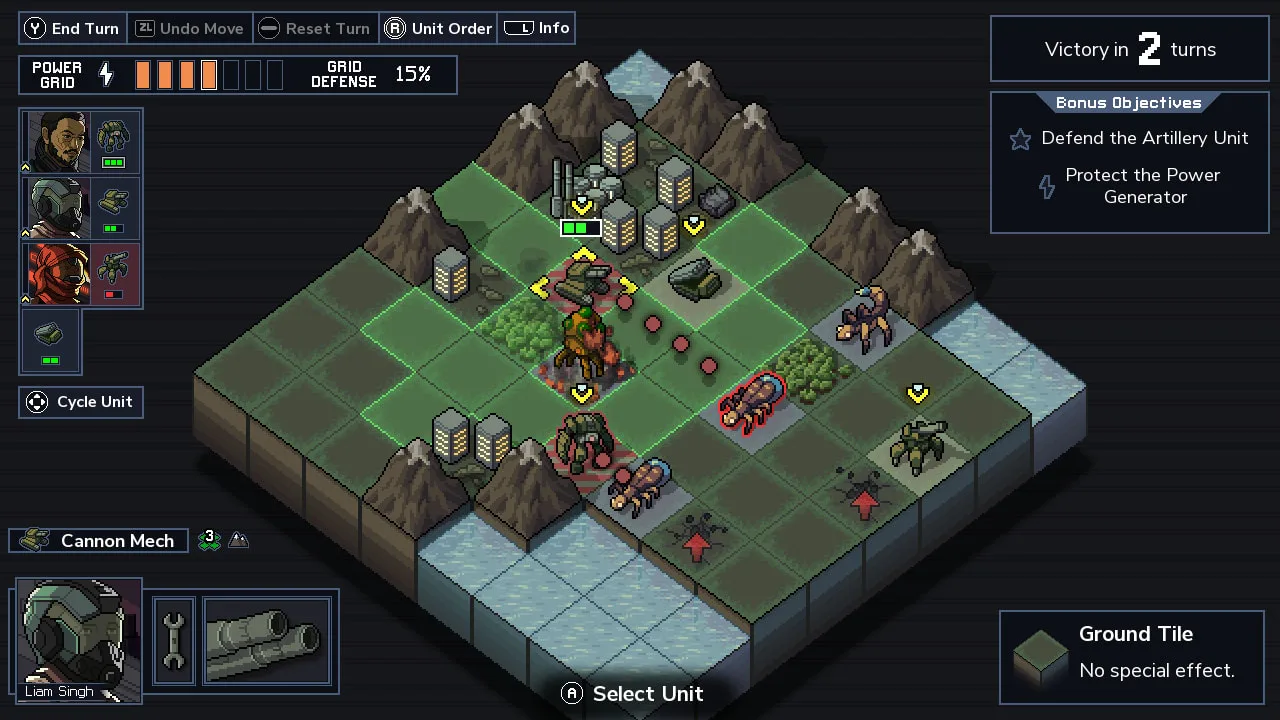
When is a turn-based strategy game not a turn-based strategy game? Into the Breach, an indie roguelike game where you control mechs to stem an alien attack, defies conventions, and is all the better for it. While its core mechanics are very much in the XCOM (or Fire Emblem, for that matter) mold, it's what it does with those mechanics that's so interesting. A traditional turn-based strategy game plays out like a game of chess — you plan a move, while predicting what your opponent will do in return, and thinking ahead to what you'll do next, and so on, with the eventual goal of forcing them into a corner and winning. At the start of every Into the Breach turn, the game politely tells you exactly what each enemy character is going to do, down the exact square they'll end on and how much damage they'll inflict. There are no hit percentages, no random events, no luck; each turn is a puzzle, with definitive answers to how exactly you're going to come out on top. Into the Breach battles are short, and being a roguelike, designed to be very replayable. Once you've mastered the basics and reached the end, there are numerous different mechs with new attack and defense mechanics to learn and master as you mix-and-match to build your favorite team. If you're a fan of either puzzle or turn-based strategy games, this is a must-have. Buy Into The Breach at Amazon - $15 The Legend of Zelda: Breath of the Wild
Nintendo
The Legend of Zelda: Breath Of The Wild signals the biggest shift in the series since the Nintendo 64's Ocarina of Time, and it might well be one of the best games of the past decade. It pulls the long-running series into modern gaming, with a perfectly pitched difficulty curve and an incredible open world to play with. There's crafting, weapons that degrade, almost too much to collect and do and a gentle story hidden away for players to discover for themselves. Even without the entertaining DLC add-ons, there's simply so much to do here and challenges for every level of gamer. Buy Breath of the Wild at Amazon - $40 Disco Elysium Final Cut
ZA/UM
Disco Elysium is a special game. The first release from Estonian studio ZA/UM, it's a sprawling science-fiction RPG that takes more inspiration from D&D and Baldur's Gate than modern combat-focused games. In fact, there is no combat to speak of, instead, you'll be creating your character, choosing what their strengths and weaknesses are, and then passing D&D-style skill checks to make your way through the story. You'll, of course, be leveling up your abilities and boosting stats with items, but really the game's systems fall away in place of a truly engaging story, featuring some of the finest writing to ever grace a video game. With the Final Cut, released 18 months after the original, this extremely dialogue-heavy game now has full voice acting, which brings the unique world more to life than ever before. After debuting on PC, PS5 and Stadia, Final Cut is now available for all extant home consoles – including Nintendo’s Switch. Loading times are a little slower than on other systems, so it might not be the absolute best platform to play it on, but Disco Elysium is an experience unlike the rest of the Switch library, which is why it makes it on this list. Buy Disco Elysium Final Cut at Amazon - $40 Mario Kart 8 Deluxe
Nintendo
Mario Kart 8 Deluxe's vibrancy and attention to detail prove it's a valid upgrade to the Wii U original. Characters are animated and endearing as they race around, and Nintendo's made bigger, wider tracks to accommodate up to 12 racers. This edition of Mario Kart included gravity-defying hover tires and automatic gliders for when you soar off ramps, making races even more visually thrilling, but at its core, it's Mario Kart — simple, pure gaming fun. It's also a great showcase for the multitude of playing modes that the Switch is capable of: Two-player split-screen anywhere is possible, as are online races or Switch-on-Switch chaos. For now, this is the definitive edition. Buy Mario Kart 8 Deluxe at Amazon - $50 OlliOlli World
Roll7
OlliOlli and its sequel, OlliOlli 2: Welcome to Olliwood, were notoriously difficult to master. They were infuriating, but also extremely satisfying when you pulled off just the right combo of tricks and grinds needed for a big score. I was worried that OlliOlli World’s colorful and welcoming new direction for the series was going to dispense with that level of challenge, but I shouldn’t have been concerned. Developer Roll7 made a game that’s significantly more approachable than the original titles — but one that keeps the twitch-response gameplay and score-chasing highs intact for those who crave them. It’s hard to sum up exactly what makes OlliOlli World so compelling, but the game mixes serious challenges with moments that let you really get into that elusive flow state, where you’re just pulling off tricks, riding rails and generally tearing through a course without thinking too much about what you’re doing. The music, sound effects, art style, level design and variety of moves you can pull off all contribute to this vibe — and even though the game looks entirely different from its predecessors, the end result is the same: skateboarding bliss. Buy OlliOlli World at Amazon - $30 Super Mario 3D World + Bowser’s Fury
Nintendo
Super Mario 3D Worldwas unfairly slept on when it originally launched in 2013, mostly due to the fact very few people had a Wii U. It's a superb translation of old-school Mario mechanics into 3D (Mario 64 is a masterpiece, yes, but unless you're a speed-runner it doesn't quite have the pace of the NES and SNES games). It's also a great multiplayer game, as you can play simultaneously with three other players and race through levels — the winner of each level gets to wear a crown in the next. With the move to the Switch, and Nintendo finally starting to figure out online gaming, you can now do that remotely, which is a huge plus. The bigger addition is Bowser's Fury, an all-new game of sorts that plays more like a blend of Super Mario Odyssey and 3D World. There are some really creative challenges that feel right out of Odyssey, blended with the lightness and speed of the Wii U game. (It should be noted that Bowser's Fury is also only good for one or two players, unlike the main game.) We'd recommend 3D World just on its own, but as a package with Bowser's Fury, it becomes a much better deal. Buy Super Mario 3D World at Amazon - $60 Super Mario Odyssey
Nintendo
Super Mario Odyssey might not represent the major change that Breath of the Wild was for the Zelda series, but it’s a great Mario game that's been refined across the last two decades. Yes, we got some important modern improvements, like maps and fast travel, and the power-stealing Cappy is a truly fun addition to Mario's usual tricks. But that core joy of Mario, figuring out the puzzles, racing to collect items and exploring landmarks, is here in abundance. Buy Super Mario Odyssey at Amazon - $60 Super Smash Bros. Ultimate
Nintendo
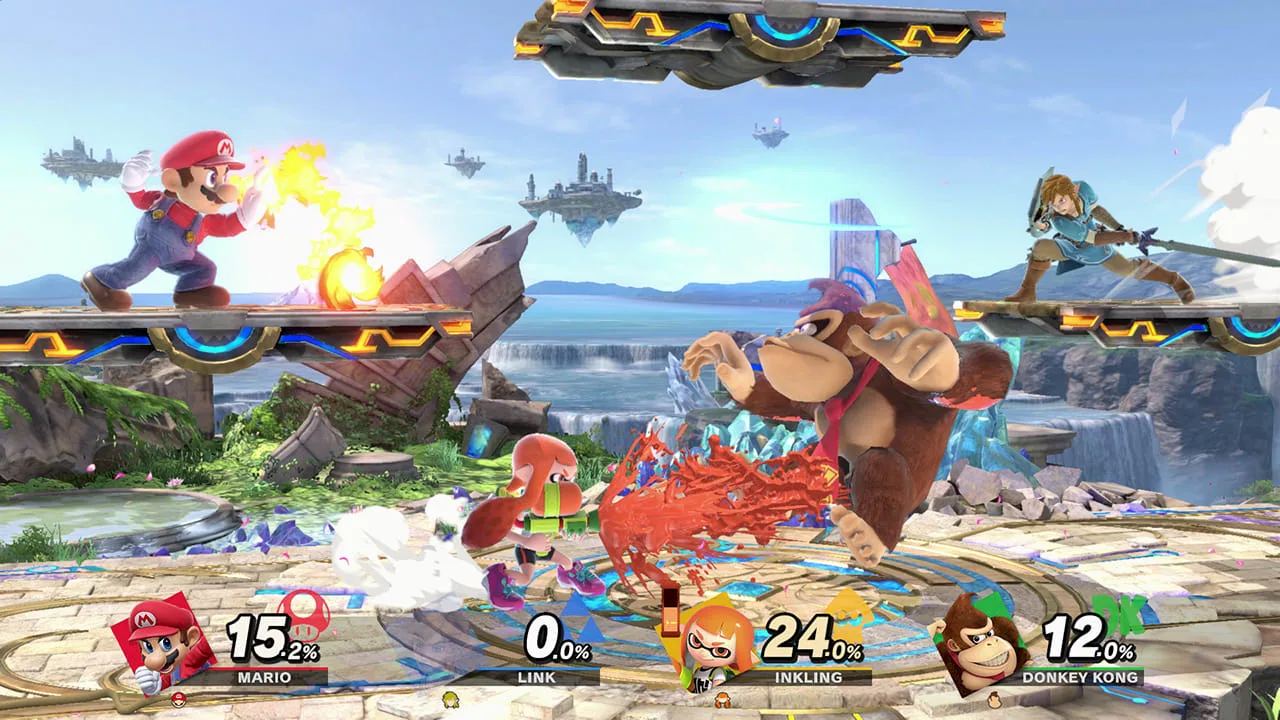
This is the ultimate distillation of Nintendo's multiplayer fighting game. The series' debut on Switch brings even more characters from beyond Nintendo's stable. If you're sick of Mario, Pikachu and Metroid's Samus, perhaps Final Fantasy VII's Cloud, Solid Snake or Bayonetta will be your new go-to character. There are about 80 characters to test out here (although 10 of them are locked behind DLC). Super Smash Bros. Ultimate features a divisive new single-player mode where you augment characters with stickers, battling through special conditions to unlock more characters and, yes, more stickers. At its core, Smash Bros. games combine fast-paced, chaotic fights with an incredibly beginner-friendly learning curve. Yes, some items are confusing or overpowered, but your special moves are only a two-button combination away. Turning the tables is built into the DNA of Super Smash Bros. Ultimate, ensuring thrilling battles (once you've sorted handicaps) for everyone involved. Buy Super Smash Bros. Ultimate at Amazon - $60View All Comments Sam Rutherford/Engadget The best cheap Windows laptops for 2022 Chromebooks aren’t always the answer if you have a limited budget. V. Palladino @valentinalucia October 17, 2022 11:06 AMIn this article: thebuyersguide, gear, Lenovo, evergreen, back to school, commerce, acer, Windows, best tech, feature, Microsoft, laptop, holiday gifts
All products recommended by Engadget are selected by our editorial team, independent of our parent company. Some of our stories include affiliate links. If you buy something through one of these links, we may earn an affiliate commission. All prices are correct at the time of publishing. If you’re a regular Engadget reader, you probably don’t think of cheap Windows laptops when you think of daily drivers. But it would be a big mistake to ignore these devices — if not for yourself, for others you may know. There’s a reason why companies like Acer, ASUS, Dell and the like make Windows devices under $500 — lots of people have strict budgets to adhere to and others just don’t need the power that comes with a flagship laptop. Affordable Windows notebooks are great options for people that only use a computer to check email, shop online or post on Facebook. (Hello, mom and dad?) They’re also good for kids who have no business putting their sticky little hands on a $2,000 gaming rig. And, depending on what you need them for, these devices can be decent daily drivers, too. Engadget's picks Acer Aspire 5 Lenovo IdeaPad Flex 5 Surface Laptop Go 2 What about Chromebooks and tablets? Now, you may be inclined to recommend a Chromebook or a tablet to all of the people listed above. Those instincts aren’t wrong, but Chromebooks and tablets aren’t for everyone. Tablets will only work for the most mobile-competent users like kids who have been grabbing smartphones out of their parents’ hands since they’ve been dexterous enough to do so. Tablets can also be just as expensive as some of the cheapest Windows laptops, and that’s without a mouse or keyboard. Chromebooks are a good alternative for those that basically live in a browser. However, there are some who just don’t want to give up the “traditional desktop.” And Chrome OS is more limited than Windows when it comes to the programs you can install and run. What Windows laptops do well
Wachiwit via Getty Images
So what can you realistically accomplish on a cheap Windows laptop? Quite a bit, especially if you’re doing one thing (or a limited number of things) at a time. They’re great for web browsing, checking email, video streaming and more — but, yes, all of those things can be done on Chromebooks as well. Windows laptops have a big advantage, though, in Microsoft Office. While yes, there is a browser based version, the native, desktop apps are considered a must have for many and will run smoothly on even the most bare-bones budget laptop. The only caveat is that you may run into some slowdown on low-powered devices if you’re working with large data sets in Excel or a lot of photos and graphics in Powerpoint. When it comes to specs, a bright spot for Windows laptops is storage. Even the most affordable devices tend to have at least 128GB SSDs. That will come in handy if you prefer to keep your most important files saved locally on your laptop. In contrast, cheaper Chromebooks often have less storage because they’re built on the assumption that you’ll save all of your documents in the cloud. Not only is that less convenient when you need to work offline, but it also limits the size of programs and files that you can download. So, not great for hoarding Netflix shows before a long trip or using a Chromebook as a gaming laptop. Windows also has thousands of apps that you can download from its app store. Chromebooks have some Chrome apps, numerous browser extensions and the ability to download Android apps, but quality control is… inconsistent. Android apps, in particular, often haven’t been optimized for Chrome OS, which makes for a wonky user experience. Windows may not have as many apps as Android, but at least the experience is fairly standard across the board. Windows also gives you the ability to download and use programs from other sources, like direct from the developer. You can run things like Adobe Creative Suite, certain VPNs and programs like GIMP, Audacity and ClipMate on a Windows device, which just isn’t possible on Chrome OS. Chromebooks limit you to the apps and programs in The Play Store and the Chrome Extensions store, reducing any others to unusable, space-sucking icons in your Downloads folder. What to look for in a cheap Windows laptop While you can do a lot even when spending little on a Windows laptop, you must set your expectations accordingly. The biggest downside when purchasing a budget laptop (of any kind, really) is limited power. Many Windows laptops under $500 run on Intel Celeron or Pentium processors, but you can find some with Core i3/i5 and AMD Ryzen 3/5 CPUs at the higher end of the price spectrum. Specs to look for in a sub-$500 Windows laptop Intel Core i or AMD Ryzen 3 processors 8GB of RAM An SSD with at least 128GB of space 1080p display Mostly metal designs We recommend getting the most powerful CPU you can afford because it will dictate how fast the computer will feel overall. RAM is also important because, the more you have, the easier it will be for the laptop to manage things like a dozen browser tabs while you edit a Word document and stream music in the background. However, with sub-$500 laptops, you’re better off getting the best CPU you can afford rather than a laptop with a ton of RAM because the CPU will have enough power to handle most tasks that cheap laptops are designed for (If you’re editing RAW images or 4K video, you’ll want to invest in more RAM… and a laptop well above $500). When it comes to storage, consider how much you want to save locally. If you primarily work in Google Docs or save most things in the cloud, you may not need a machine with a ton of onboard storage. Just remember that your digital space will also be taken up by apps, so it may be worth getting a little extra storage than you think you need if you know you’ll be downloading big programs. A final side note: SSDs are ubiquitous at this point, not to mention faster and more efficient than HDDs, so we recommend getting a laptop with that type of storage. You also don’t have to settle for an entirely plastic notebook either. There are options in the sub-$500 price range that are made, at least in part, with metals like aluminum. Those will not only be more attractive but also more durable. As for screens, there’s a healthy mix of HD and FHD options in this price range and we recommend springing for a notebook with a 1080p display if you can. Touchscreens aren’t as common in the under-$500 space as standard panels, but you’ll only really miss one if you get a 2-in-1 laptop. A final note before we get to our picks: The best cheap laptop models change all the time. Unlike more expensive, flagship machines, these notebooks can be updated a couple times each year. That can make it hard to track down a specific model at Amazon, Best Buy, Walmart or any given retailer. We’ve listed some of our current favorite models below, but if you can’t find any of them available near you, just keep in mind our list of specs to look for in a cheap laptop – they’ll guide you to the best machines available at the moment. Acer Aspire 5
Valentina Palladino / Engadget
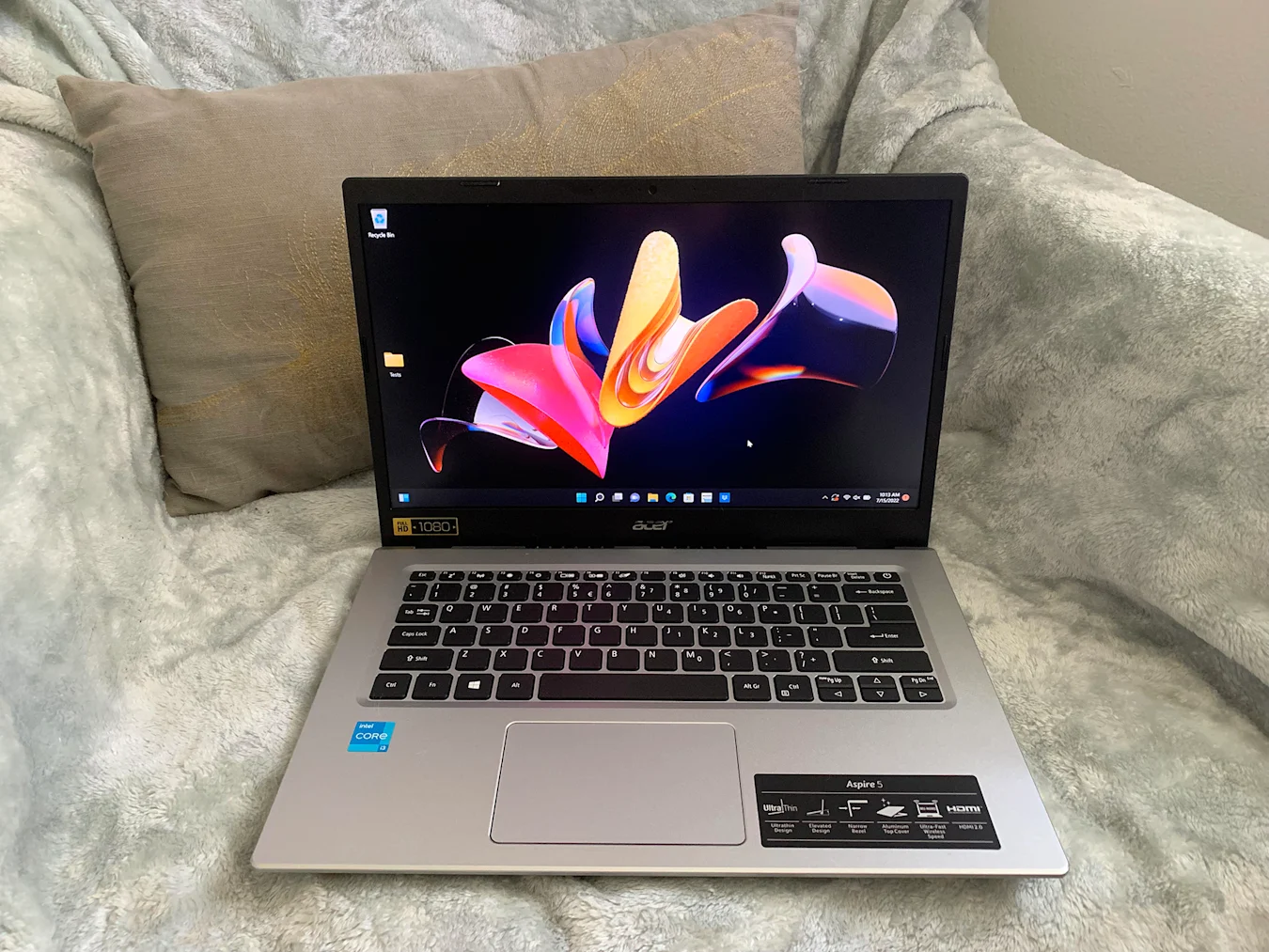
Acer’s Aspire 5 series has been a reliable pick for quite some time now. Most recently, we tested out the A514-54-395V, which has a 14-inch 1080p display and runs on an 11th-gen Intel Core i3 processor, 8GB of RAM and 256GB of storage. Performance was similar to the previous Aspire 5 model that we tested, but you will find some design differences on the A514-54-395V. Namely, it’s a 14-inch machine, not a 15-inch one, and it doesn’t have a full number pad on the right side of the keyboard. It still has an aluminum top cover, which gives it a more premium feel, but Acer removed the backlight on the keyboard on this one, which is a bummer. Thankfully, though, the keyboard is just as comfortable to use as the one on the previous model. In addition to new WiFi 6 support, the latest Acer Aspire 5 has an additional, crucial USB-C port. This was lacking on the previous model we tested, so we’re happy to see it included on this version. And it accompanies the ports that were already present: three USB-A connections, one HDMI socket, a headphone jack, a lock slot and a drop-jaw Ethernet port. As promised, Acer increased the average battery life on this model to 10 hours. On the previous model, we were clocking in roughly six hours of battery life, so this is a much-needed improvement. Buy Acer Aspire 5 at Adorama - $460 Lenovo IdeaPad Flex 5
Valentina Palladino / Engadget
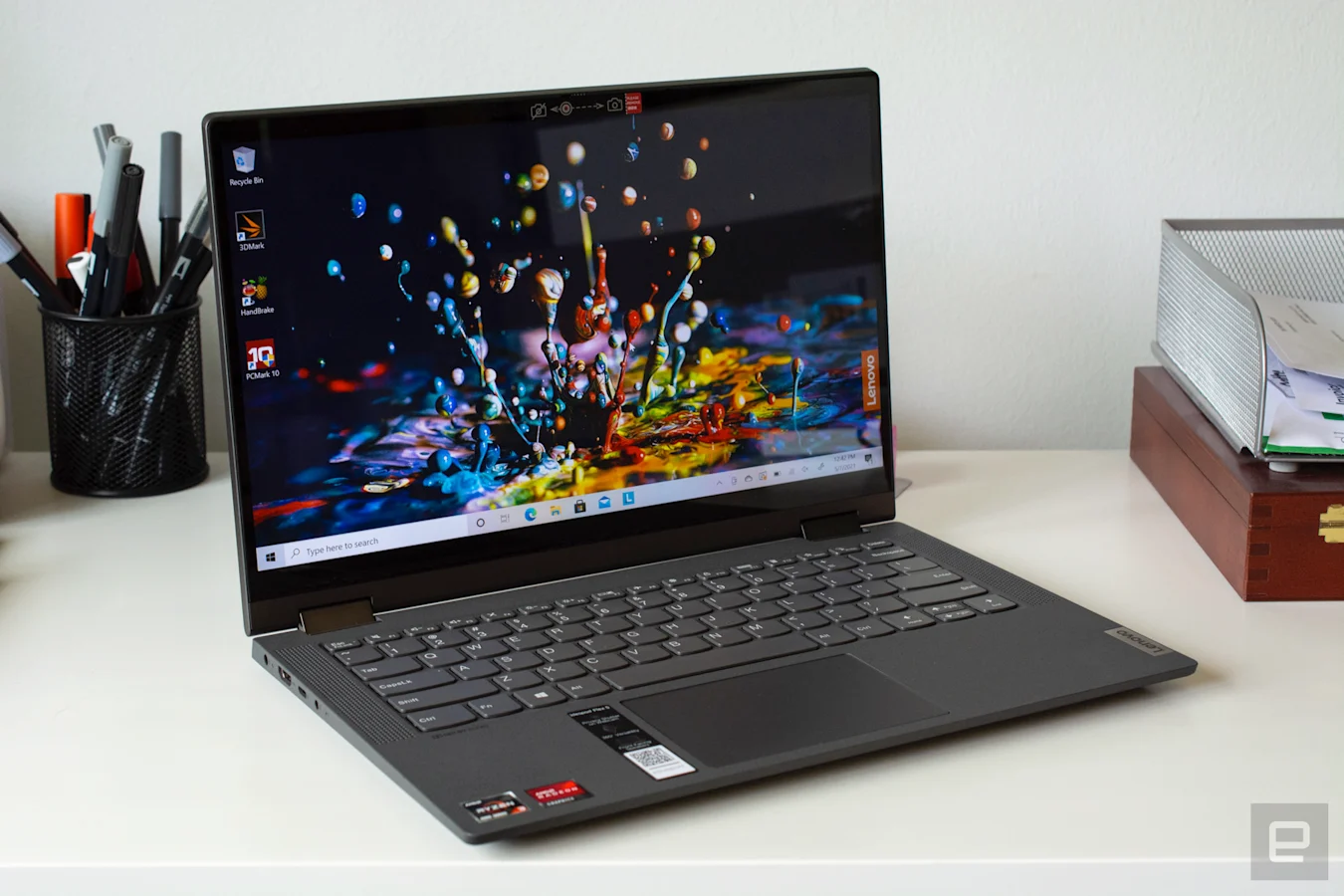
Lenovo’s Flex 5 14 is a good alternative if you want a more portable laptop with a battery life that will keep you going all day long. It runs on an AMD Ryzen 3 4300 processor, with 4GB of RAM and a 128GB SSD, and it’s accompanied by a 14-inch 1080p IPS display and an array of ports that includes one USB-C connection. If you care about future-proofing, that USB-C port will be critical. You may not have a lot of USB-C accessories right now, but that will most certainly change in the coming years. The typing experience is also top-notch: while it doesn’t have a number pad, its keys have that rounded-bottom shape that’s similar to keys on Lenovo’s ThinkPad machines. They make a satisfying clicking sound while you’re typing, but they’re not loud enough to bother those around you. And despite being a budget machine, the Lenovo Flex 5 14 isn’t flimsy. The palm rests don’t creak under pressure and it’s easy to carry this laptop one-handed around a room. I also appreciate its convertible design, which gives you more flexibility. And like most Lenovo machines, the Flex 5 14 has a webcam that you can cover with a physical shutter. The Flex 5 14 also has the upper-hand over the Aspire 5 when it comes to battery life: The former lasted about 16.5 hours in our testing, whereas Acer’s machine lasted roughly 10 hours. That makes the Lenovo option the clear winner if you’re looking for a laptop that can last all day and then some. Buy Lenovo Flex 5 14 at Walmart - $485 Surface Laptop Go 2
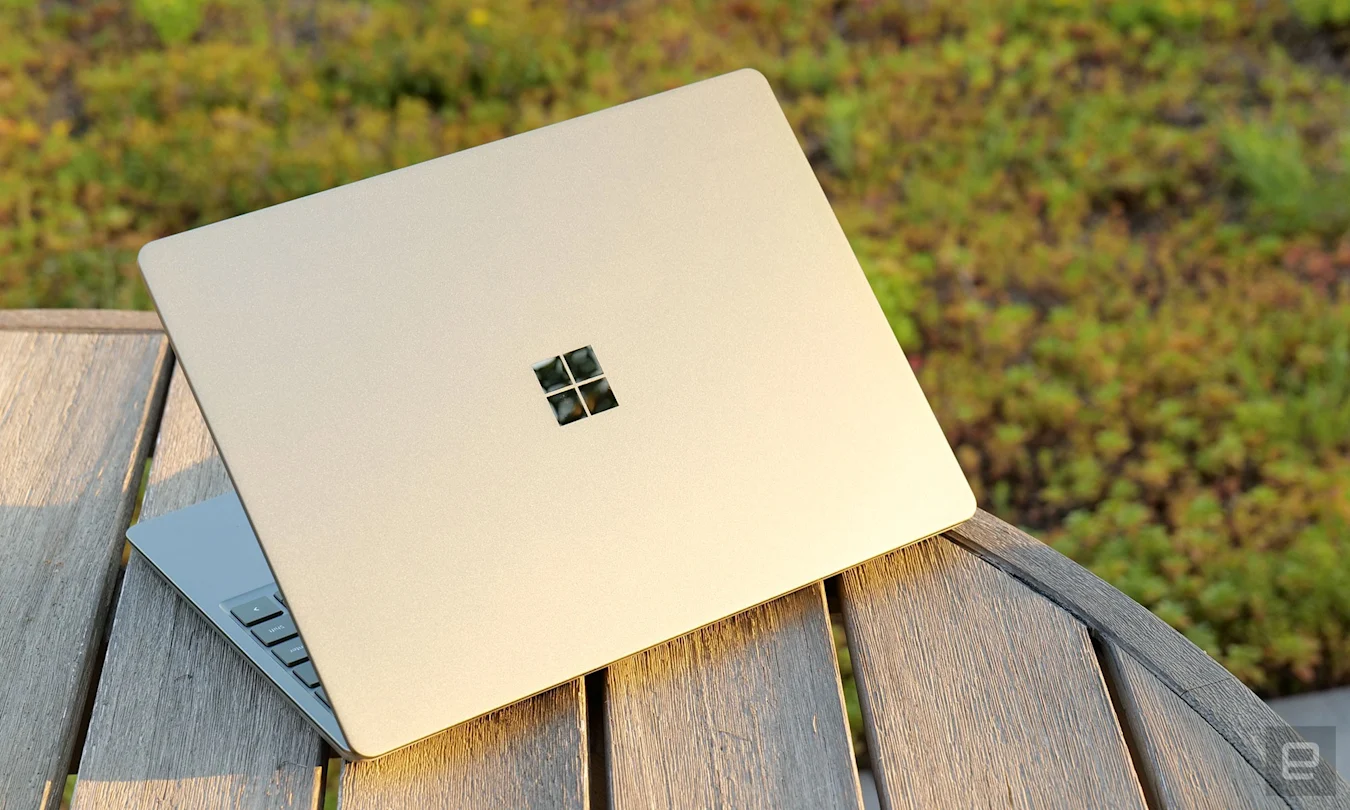
Sam Rutherford/Engadget
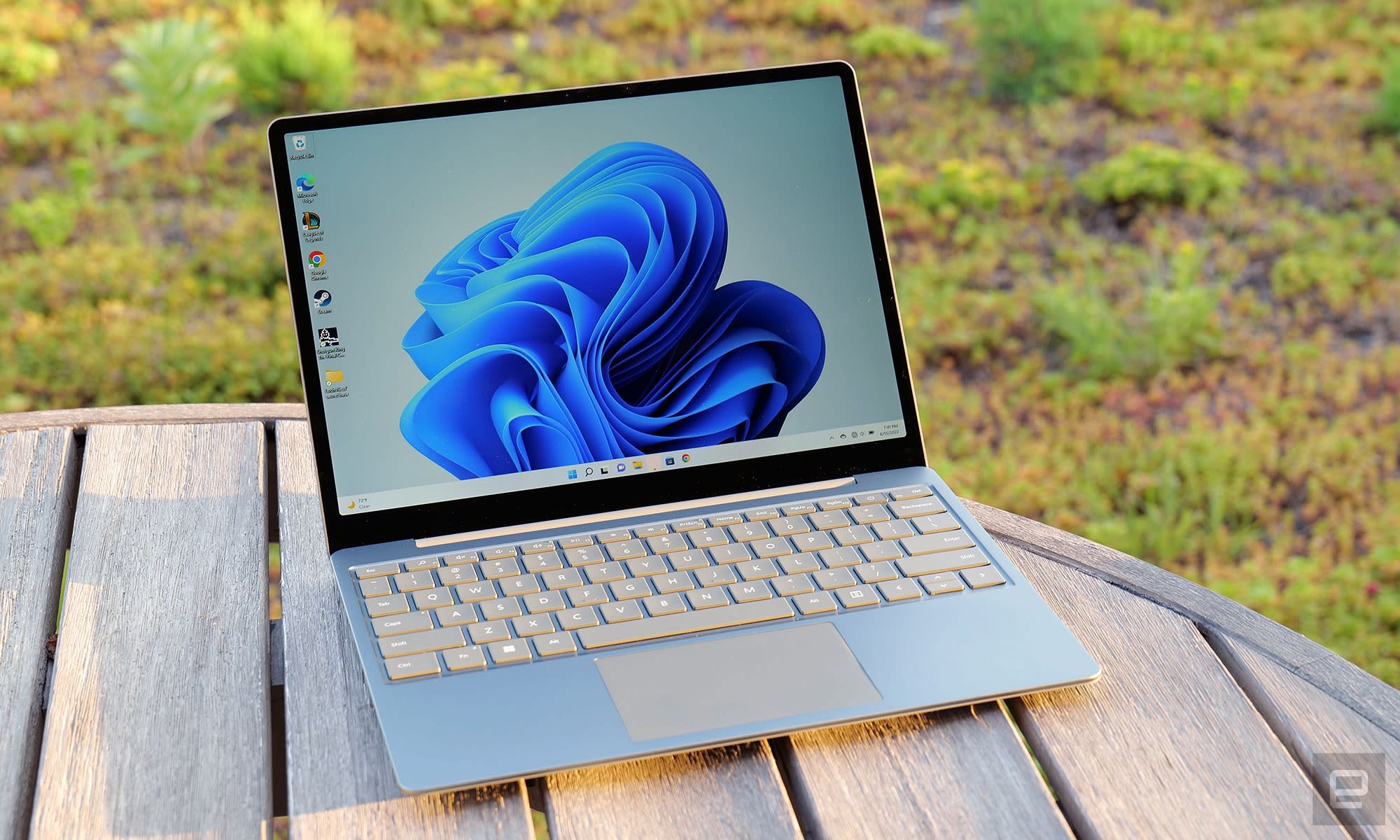
We’d be remiss if we didn’t mention Microsoft's new Surface Laptop Go 2 here, even though it starts at $600. It’s certainly a decent option to consider if you’re really into the Surface Go line. Undoubtedly, the Laptop Go 2 has one of the best designs you’ll find on any cheap Windows notebook, with a minimalist aesthetic, thin bezels surrounding its display and a relatively like 2.5-pound weight. It’s 12.4-inch PixelSense touchscreen has 1,536 x 1,024 resolution, and it’s still pretty crisp despite not being an FHD panel. You’re also getting a 720p webcam, a fairly comfortable keyboard (albeit with no backlight) and a port array that includes one USB-A connection, one USB-C socket, a headphone jack and a power slot. In addition to the attractive design, another reason why you may want to spring for the Microsoft Surface Laptop Go 2 is that even the base model runs on an 11th-gen Intel Core i5 processor. We found it to provide snappy performance, and you’ll probably notice a difference if you’re coming from a machine with a Core i3 processor or something even less powerful. We were also impressed by the Laptop Go 2’s battery life – it lasted nearly 15 hours in our testing, and since Microsoft improved the interior thermal system, you shouldn’t hear excessive fan noise when you’re using it. There are two big downsides to the Laptop Go 2: the higher starting price and the base model’s 4GB of RAM. You’ll pay $600 for a machine with a Core i5 processor, 4GB of RAM and a 128GB SSD, and while those specs aren’t terrible, we usually recommend spring for a machine with at least 8GB of RAM. It’ll make multitasking much easier and more efficient, thereby improving your experience using the notebook in the long run. You’ll have to spend $700 to get that amount of memory in the Laptop Go 2, which is still cheaper than flagship notebooks, but not as affordable when compared with the other laptop computers we picked. Buy Surface Laptop Go 2 at Microsoft starting at $600View All Comments Anker Anker's October Prime Day deals bring charging accessories down to new record lows The brand has powerbanks, power strips and cables on sale at Amazon. M. Moon @mariella_moon October 11, 2022 6:45 AMIn this article: thebuyersguide, news, Amazon, gear, engadgetdeals, shopping, Prime Day, Anker, commerce, streamshopping All products recommended by Engadget are selected by our editorial team, independent of our parent company. Some of our stories include affiliate links. If you buy something through one of these links, we may earn an affiliate commission. All prices are correct at the time of publishing. Anker is selling quite a robust selection of products at a discount for Amazon's Prime Early Access Sale, and some of the deals even represent new all-time lows for the items. If you need to make sure your devices don't ever run out of battery, the Anker 737 Power Bank is currently on sale for $100, or $50 less than its retail price. The model has a 24,000mAh battery capacity and has two USB-C, as well as one USB-A, charging ports. Anker says it carries enough juice to charge an iPhone 13 for almost five times, though that number would probably be lower if you have an iPhone 14. Shop Anker Prime Day deals Need a portable wireless battery for your iPhone instead? The black variant of the Anker 633 Magnetic Battery (MagGo) is currently on sale for $55. That's $25 off and the lowest we've seen for the wireless charger on the website. The device has a small kickstand attachment, and since it sticks to your iPhone while charging, it also doubles as a phone stand. This one's a bit smaller than the 737 Power Bank and has a 10,000mAh battery capacity with a 20W USB-C power delivery port for fast charging times. The white and blue versions are also on sale, but they cost a bit more at $64. If you're traveling or just simply need a power strip with an abundance of ports and outlets, you can get Anker's 727 Charging Station for $66.50, or 30 percent off its usual price. That's the lowest we've seen for the power strip, which has a maximum output of 100W. The 727 Charging Station has two USB-C ports, two USB-A ports and two AC outlets, and it comes with a five-foot detachable cord. In case you need cords to be able to connect your iPhones and iPads to a USB-C charger, you can also grab a bunch from the sale. A 3-pack bundle of Anker's Powerline II USB-C-to-Lightning Cable will set you back $22, or $17 lower than usual. The cables come in different lengths — three feet, six feet and 10 feet — and had been tested to withstand up to 12,000 bends. There are a lot more Anker items on sale at the moment, but they are exclusive to Prime members. If you're a new user or haven't been a Prime subscriber over the past 12 months, though, you can sign up for a 30-day free trial. Get the latest Amazon Prime Day offers by following @EngadgetDeals on Twitter and subscribing to the Engadget Deals newsletter.View All Comments Latest Reviews See all articles 87 Devindra Hardawar/Engadget Intel Arc A750 and A770 review: Trouncing NVIDIA and AMD on mid-range GPU value These may be the affordable mid-range GPUs you've been waiting for. D. Hardawar @devindra October 5, 2022 9:00 AMIn this article: GPU, gear, Arc A770, gaming, Arc A750, video card, review, Intel Not too long ago, the notion of Intel getting into the world of discrete graphics cards seemed ludicrous. Intel?! The same company that killed its last major GPU project in 2009 and spent the 2010s focusing on weak integrated graphics? The same one that turned to AMD when it needed a decent GPU to sit alongside its CPU for enthusiast laptops? But after tempting Raja Koduri away from AMD, the engineer who spearheaded the powerful-yet-inexpensive Radeon RX480, it started to seem like Intel was finally getting serious about gaming GPUs. Since then, the company's new Xe graphics have beefed up its notebook CPUs and popped up in the DG1 card for developers.Intel Intel Arc A750 87 SCORE Engadget 87 Critics - Not yet scored N/A Users - Not yet scored N/A Pros
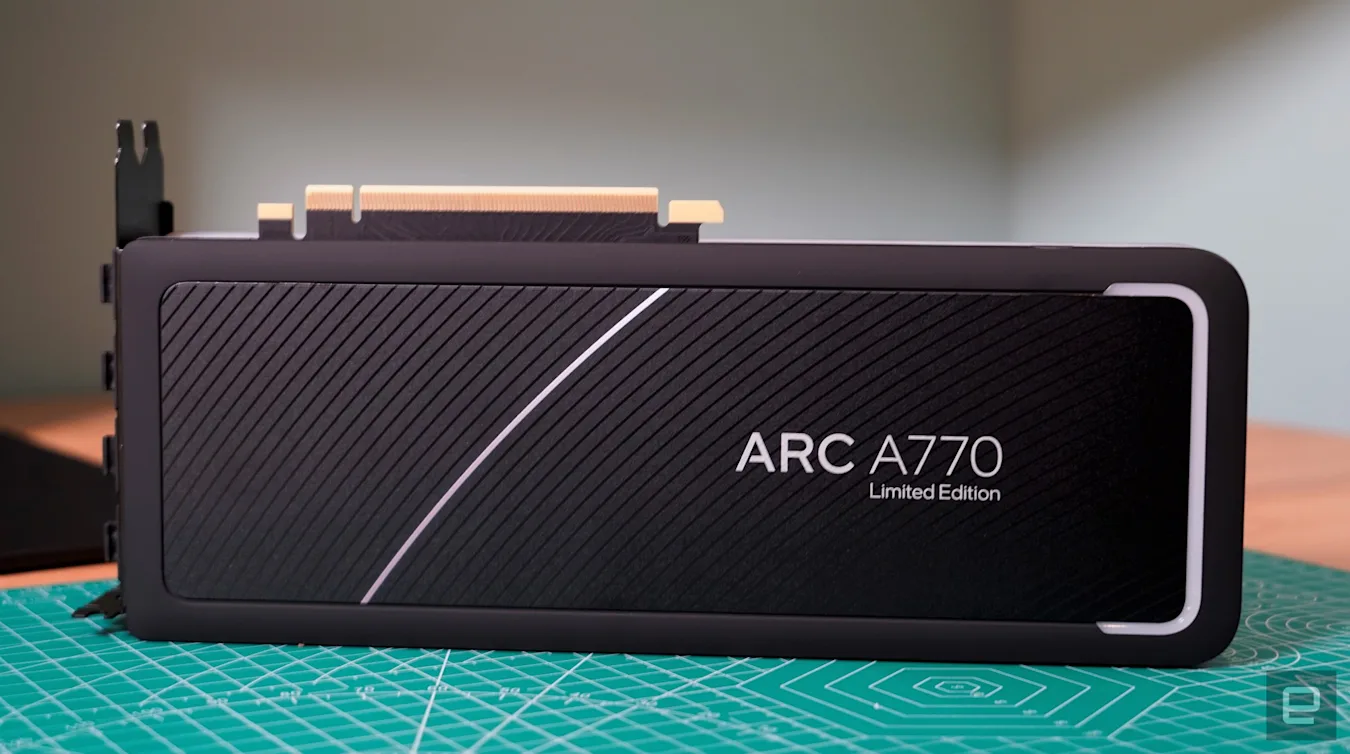
Gallery: Intel Arc A750 and A770 | 7 Photos1/7 Now comes the real test: Can Koduri and the Intel crew actually make GPUs gamers will want? After spending some time with the Arc A750 and A770 , it's clear that the company has developed cards that can easily take on NVIDIA and AMD's alternatives. But most importantly, they're aiming to deliver that power a lower price. The A750 is launching at $289, while the A770 starts at $329 (with a Limited Edition card at $349). Theoretically, that puts the A770 on par with the RTX 3060's original price. But thanks to the wild GPU market, NVIDIA's card currently goes for around $400. We've yet to see how retailers will price Intel's cards, but the company's representatives have claimed they're pushing stores to stick to their low launch pricing. If that's the case, Intel's Arc GPUs will end up being something truly rare in the video card world today: good deals.
Devindra Hardawar/Engadget
I was impressed the moment I opened the Arc A750 and A770 boards sent for review. After testing Intel's recent NUC Extreme systems, I was expecting some fairly practical-yet-dull gamer chic. But these cards are genuinely sleek. They're well-built, have a finger print-free matte finish, and aside from the modest LEDs around the A770's fans, there's no annoying bling in sight. These certainly don't feel like Intel's first consumer graphics cards. They're more like stealth bombers built with the express purpose of obliterating NVIDIA and AMD's price-performance ratios. Powering these beauties is the latest evolution of Intel's "Alchemist" Xe graphics architecture. The Arc A750 features 28 Xe cores, 28 ray tracing units, a 2,050 MHz clock speed and 8GB of GDDR6 RAM. The A770 doubles that memory and has more power across the board: 32 Xe cores and ray tracing units, as well as a 2.1 GHz speed. Both cards have a 225W TDP, which means they will end up drawing more power and heat than the 170W RTX 3060. (I typically saw them hit around 76C under heavy load, six degrees more than NVIDIA's card.)
Timespy Extreme
Hitman 3
Luxmark Luxball HDR
Intel Arc A770
6,718
117 fps (144 with XeSS)
52,055
Intel Arc A750
6,355
110 fps (135 with XeSS)
49,854
NVIDIA RTX 3060 Ti
5,408
124 fps
45,900
NVIDIA RTX 3070 Ti
6,842
155 fps
53,114
AMD Radeon 6600XT
3,973
94 fps
22,567
I figured the beefier Arc A770 would outmatch the RTX 3060 Ti (I didn't have a chance to review the 3060 at launch), but I was genuinely surprised by how well both cards faired in our benchmarks. The A750 scored over 900 more points than the 3060 Ti in the 3DMark Time Spy Extreme benchmark, landing just above the the RTX 3070. I was also able to hit 74 fps while playing Halo Infinite in 1440p with all of the graphics settings maxed out. That's not at all what I expected from a GPU under $300.Image Credit: Devindra Hardawar/Engadget The Arc A770 was within reach of the RTX 3070 Ti's Time Spy Extreme score, a card that launched at $599 (and sold for much more) last year. It also proved to be a decent ray tracing contender (within reason), reaching 76 fps in Cyberpunk 2077's benchmark while playing in 1080p with the "ultra" ray tracing profile. Both GPUs scored close to the RTX 3060 Ti in 3DMark's Port Royal ray tracing benchmark, almost twice as fast as the Radeon 6600. Given how disappointing AMD's ray tracing performance has been, I was genuinely shocked that Intel was able to deliver a significantly better experience. Still, it's strange to see the A750 and A770 scoring closely in some cases. The pricier card also hit around 75 fps while playing Halo Infinite in 1440p, and they were both within a few thousand points of each other in the Luxmark HDR OpenCL benchmark. That's both a testament to Intel's graphics architecture, and a sign that its drivers may need some work. (Another sign: Control didn't think either card was compatible with DirectX 12 ray tracing.) NVIDIA's RTX 3060 Ti held a slight lead on both of Intel's cards in Hitman 3, though I was able to get a decent performance boost of 30 fps when I enabled Intel's XeSS technology. Similar to DLSS on RTX GPUs, it uses AI processing to upscale images rendered at lower resolutions. I didn't notice any artifacts during the Hitman benchmark, though I didn't have a chance to spend a ton of time playing it with XeSS enabled. You'll find XeSS support on titles like Call of Duty: Modern Warfare II, Naraka Bladepoint and Shadow of the Tomb Raider when the Arc GPUs launch. Similar to AMD's FX Super Resolution (and unlike DLSS), Intel's upscaling tech can also work with competitor's GPUs to give everyone a framerate boost.
Devindra Hardawar/Engadget
While the Arc A750 and A770 are best suited to 1440p and 1080p gaming, they also handled my ultrawide monitor's 3,440 by 1,440 resolution decently. In Halo Infinite, I saw an average of 62 fps on the cheaper card with maxed graphics settings, while the A770 hit a smoother 70 fps. These aren't groundbreaking scores, but it was heartening to see affordable cards holding their own at higher resolutions. Despite a few hiccups, like not getting ray tracing in Control and occasional framerate hiccups in Cyberpunk, I was happy to see that Intel's Arc drivers didn't have any major issues. There were no game crashes or blue screens of death during my testing. Still, Intel needs to show it can optimize its drivers in time for major game launches (guaranteeing XeSS support in Modern Warfare II is a start). And given the company's complete abandonment of its previous discrete graphics card, Intel also has to prove that it won't just give up on these GPUs soon. Most gamers will need to rely on their video cards for several years, after all. So sure, I have hesitations about recommending these cards wholeheartedly. But if you're looking for solid deals, especially following years of ever-increasing GPU prices, the Arc A750 and A770 are tough to beat. After almost a decade of doubting Intel's graphics hardware, I can't help but feel like the gruff farmer in Babe: That'll do Intel, that'll do.All products recommended by Engadget are selected by our editorial team, independent of our parent company. Some of our stories include affiliate links. If you buy something through one of these links, we may earn an affiliate commission. All prices are correct at the time of publishing.View All Comments Latest Reviews See all articles 88 Devindra Hardawar/Engadget NVIDIA RTX 4090 review: Unholy power You probably don’t need it, but you will covet it. D. Hardawar @devindra October 11, 2022 9:00 AMIn this article: GPU, ray tracing, gear, gaming, RTX 4090, NVIDIA, video card, review How do you go about reviewing something like NVIDIA's RTX 4090? Just looking at its specs alone, it's obviously the fastest consumer GPU we've ever seen. So sure, I can tell you that I can play just about anything in 4K with ray tracing and every graphical nicety turned on. Hell, it can even scale up to 8K if you're a masochist. For a $1,599 video card, it damn well better. But the real question is, who is this thing actually for? Gallery: NVIDIA RTX 4090 | 11 Photos1/11 Benching the RTX 4090 against NVIDIA and AMD's older hardware is practically pointless. Of course it's far faster. Of course it'll make you jealous. If you've got the cash and you're itching to upgrade, go with God (or NVIDIA's leather-clad CEO Jensen Huang, as the company's fans see him). But for anyone else who doesn't need bleeding edge hardware, it exists purely as an object of lust. Sure, you could wait for the upcoming RTX 4080 cards, or whatever AMD has in the works, but it's not a 4090. Just like the last generation of GPUs, NVIDIA is throwing down the gauntlet with a power-hungry card for the most hardcore gamers and creators.NVIDIA NVIDIA RTX 4090 88 SCORE Engadget 88 Critics - Not yet scored N/A Users - Not yet scored N/A Pros
Incredible performance
Efficient cooling
Viable 4K ray tracing
Cons
Huge power demands
Requires 4 cables on older PSUs
Expensive
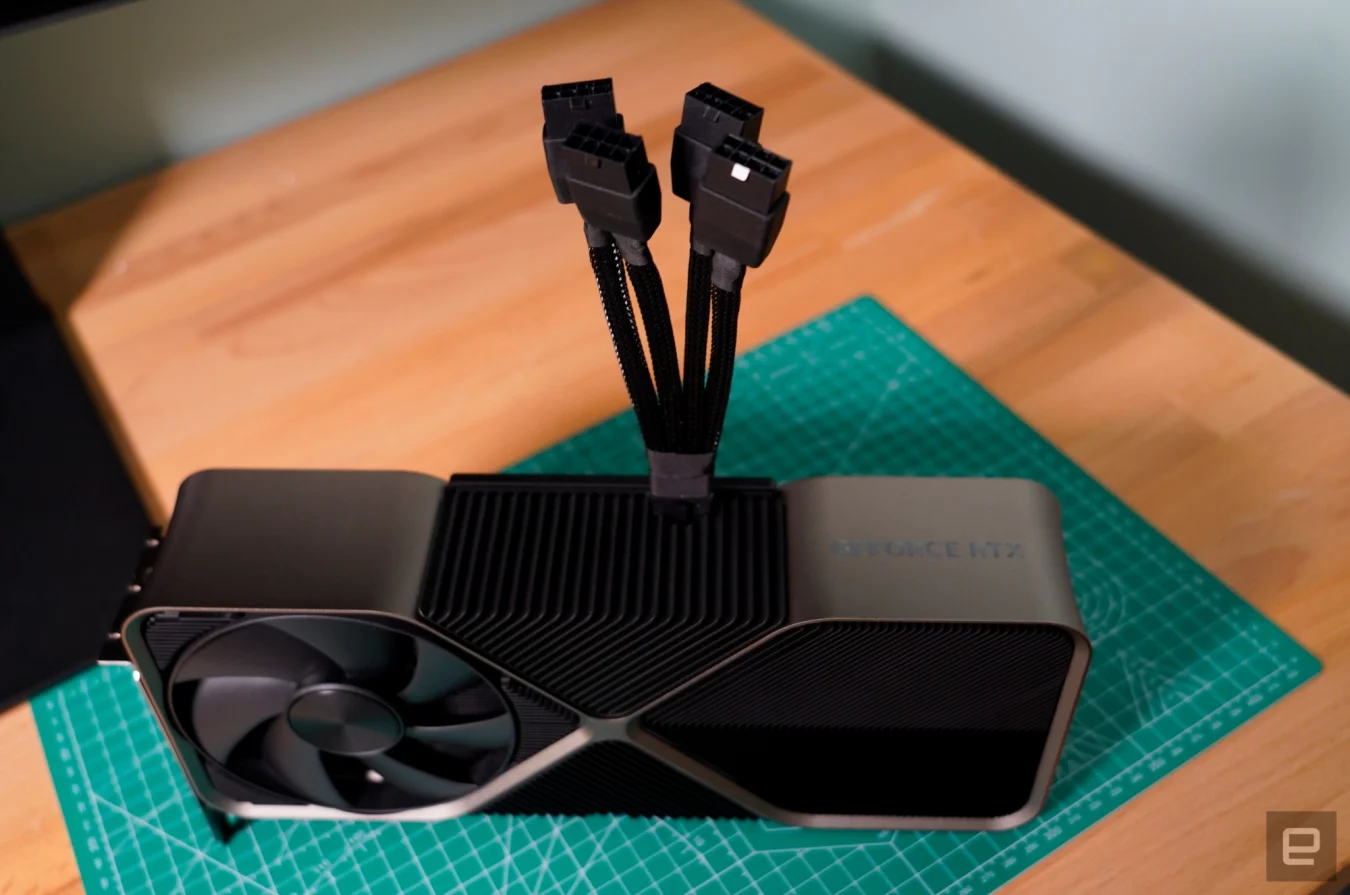
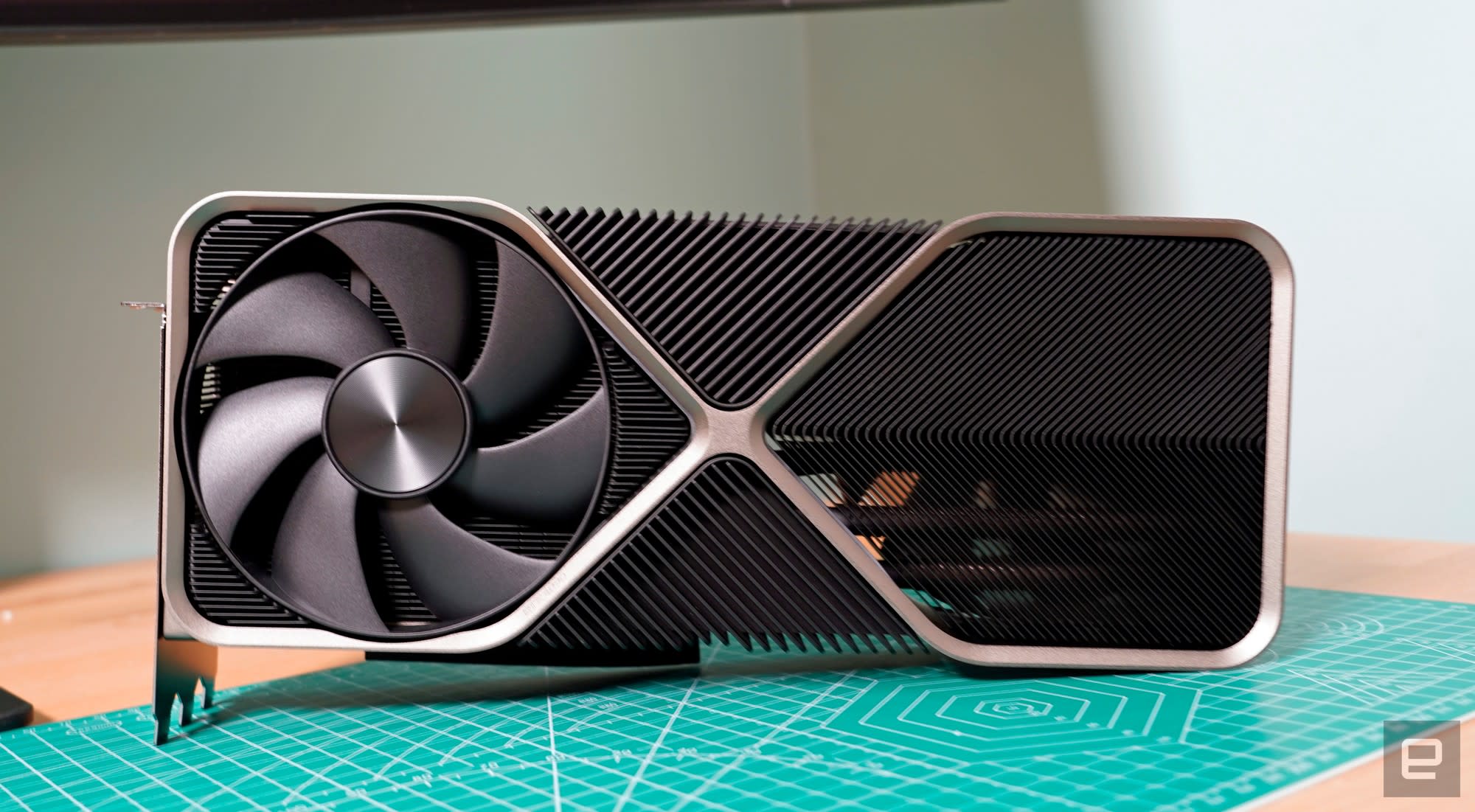
If your mind isn't made up, I assume you're here just to see how much of a beast the 4090 is. And let me tell you, it's a stunning thing to behold. Weighing in at 4.8 pounds, and approaching the size of the PlayStation 5, the RTX 4090 is a triple-slot GPU that will dominate whatever case it’s in. Seriously, if you're thinking of getting it, be sure to measure your PC to ensure you can fit a nearly foot-long card that's close to 5 inches thick.
Devindra Hardawar/Engadget
Be prepared to upgrade your power supply too: The 4090 has a high 450W TDP (the same thermal design profile as the 3090 Ti) and it requires an 850W PSU. (Some third-party companies are pushing that demand to 1200W PSUs!) While it can be powered by a single PCIe 5.0 cable, there still aren't many of those PSUs on the market, so most people will likely end up using four 8-pin adapters. I cursed Jensen's name when I realized I needed to string another PSU line, after tidying up all of my cables. Beyond its obscene power demands, though, NVIDIA hasn't changed much about the 4090 Founder Edition's design from its previous model: It's still a high-end, all-metal card with a massive vapor chamber, heatsink array and two fans on opposite sides. NVIDIA claims they can push 20 percent more air than the 3090 Ti – in my testing, that meant the 4090 stayed at a relatively cool 70C under load. What's truly special about the RTX 4090, though, is everything under the hood. It features the company's new "Ada Lovelace" architecture (named after the world's first computer programmer, though I wonder if NVIDIA pays any royalties to turn her name into marketing). It has 16,384 CUDA cores (almost 6,000 more than the 3090 Ti), a base clock speed of 2.23GHz (boost to 2.52GHz), and 24GB of GDDR6X RAM. With figures like these, the upcoming RTX 4080 cards (which start with 7,680 CUDA cores) seem puny in comparison.Image Credit: Devindra Hardawar/Engadget And really, that seems like the point of dropping the 4090 before the rest of NVIDIA's new GPUs. It's like a heavenly body so massive it warps space time around it. This is the new standard. What other GPU can get you 135fps in Cyberpunk 2049 while playing in 4K with maxed out graphics and ray tracing? To be clear, though, the 4090 isn't just about brute-force power. It was able to reach that killer Cyberpunk framerate by using DLSS 3, NVIDIA's latest AI upscaling technology that can now generate entire frames of imagery on its own. (That's in addition to upscaling lower resolution textures using AI, like earlier versions.) DLSS 3 helped A Plague Tale Requiem perform more than twice as fast while running in 4K, delivering around 175fps (up from 74fps).
None
3DMark TimeSpy Extreme
Port Royal (Ray Tracing)
Control
Blender
NVIDIA RTX 3090
16,464
25,405/117.62 fps
4K (Native) High RT: 107 fps
12,335
NVIDIA RTX 3080 Ti
8,683
12,948/59.95fps
4K (Native) 43fps Med RT
5,940
AMD Radeon RX 6800 XT
7,713
9,104/42.15fps
4K (Native) No RT 28-40
N/A
The RTX 4090 had no trouble delivering 107 fps in Control while playing in 4K with high ray tracing settings. But you know what's even better? Getting a solid 128 fps when I flipped on an older version of DLSS. It's just unfortunate it doesn't support DLSS 3 yet, because I'm sure it would eke out even better performance. Even though the game was actually being rendered in 1,440p, to my eye, DLSS still does a stunning job of making that seem like 4K. (I tested the 4090 alongside Samsung's 55-inch Arc monitor, giving me a much larger view than my typical 34-inch ultrawide screen. If there were graphical anomalies, I would have seen them.) I was particularly interested in stressing ray tracing performance on the 4090, because that was a feature that still managed to bring NVIDIA's 30-series cards to their knees. It enables more realistic lighting, shadows and reflections. For most, I'd wager the graphical facelift it delivers would be more impressive than a skyrocketing framerate count. So it's a wonder to see an NVIDIA card that can finally deliver 4K and solid ray tracing beyond 100fps. Is that worth $1,599, though? That remains unclear, especially since we don't know how the rest of the 40-series cards will compete.
Devindra Hardawar/Engadget
If you're looking for a video card that can do more than just game, the 4090 may make more sense. In the Blender 3D rendering benchmark, it scored twice as high as the RTX 3090 Ti, a GPU released earlier this year for an eye-watering $1,999. (Let's have a moment of silence for the poor souls who jumped on that card.) When it came to transcoding a short 4K clip into 1080p, the RTX 4090 was also 10 seconds faster than the 3080 Ti. That could certainly add up if you're rendering longer clips, episodes or feature films. It's hard not to covet the RTX 4090, especially once you see what it's capable of. It's a glimpse into a world where we can finally get uncompromised ray tracing. But with the $899 and $1,199 RTX 4080 cards on the horizon, it’s tough to drop the price of an entire computer just to get the best frame rates in town There's just so much more to consider these days. You could pair up one of those 4080s with a Steam Deck, for example, and bring the joys of PC gaming on the road and all over your home. Sure, you won't have the prestige of being in the 4090 club, but you'll probably end up having more fun.All products recommended by Engadget are selected by our editorial team, independent of our parent company. Some of our stories include affiliate links. If you buy something through one of these links, we may earn an affiliate commission. All prices are correct at the time of publishing.View All Comments WD Amazon Prime Early Access sale cuts Western Digital and SanDisk storage by up to 65 percent Grab a 1TB SanDisk Extreme microSD card for just $128 ($122 off). S. Dent @stevetdent October 11, 2022 4:56 AMIn this article: thebuyersguide, news, gear, engadgetdeals, storage, prime day, shopping, SanDisk, commerce, streamshopping, Western Digital All products recommended by Engadget are selected by our editorial team, independent of our parent company. Some of our stories include affiliate links. If you buy something through one of these links, we may earn an affiliate commission. All prices are correct at the time of publishing. Amazon's Prime Early Access sale is here, which for many of us, means getting more storage on the cheap. Western Digital and SanDisk are happy to oblige, with savings of up to 65 percent on microSD cards, portable SSDs, high-speed NVMe M.2 SSDs and more. Standout deals include SanDisk's Ultra 512GB microSD card ($43 or 56 percent off), the SanDisk 2TB Extreme Portable SSD ($160 or 65 percent off) and the WD 16TB Elements desktop external HDD ($240 or 47 percent off). Buy Western Digital and SanDisk storage at Amazon If you need storage on the go for video editing and other data-hungry applications, SanDisk's rugged 2TB Extreme Portable SSDs are ideal. The 2TB 1,050MB/s model is currently on sale for $160, saving you a full 65 percent on the regular $460 price. If you need even more, the 4TB model is also discounted to just $300, for a savings of 57 percent ($400 off). And finally, if more speed is in order, SanDisk's 2,000MB/s Extreme Pro Portable SSDs also have heavy discounts, with the 2TB model at $220 (57 percent off) and the 4TB model a real steal at $360 (60 percent off). SanDisk has you covered on the memory card side as well. For smartphone, drone, or GoPro storage, the 512TB Ultra microSDXS UHS-I cards are on just $44, or 56 percent off the regular price. And for more speed, grab the SanDisk Extreme 1TB card for $128, which is 49 percent off the normal $250 price. And SanDisk has big discounts on CFexpress Type B cards for the latest Fujifilm, Canon and Panasonic mirrorless cameras, with the 128GB model available for just $110, for a savings of 56 percent. Finally, Western Digital has some solid options for PC and PS5 storage updates. You can grab the 1TB WD_BLACK SN770 model (read and write speeds 5,150MB/s and 4,900MB/s) for $80 and save 38 percent. And if you more speed and space, the WD_Black SN850 2TB model (read speed 7,000 MB/s and write speed 5,300 MB/s) is just $208, saving you 31 percent. x
Turn on browser notifications to receive breaking news alerts from Engadget
You can disable notifications at any time in your settings menu.

















 Pros
Pros Pros
Pros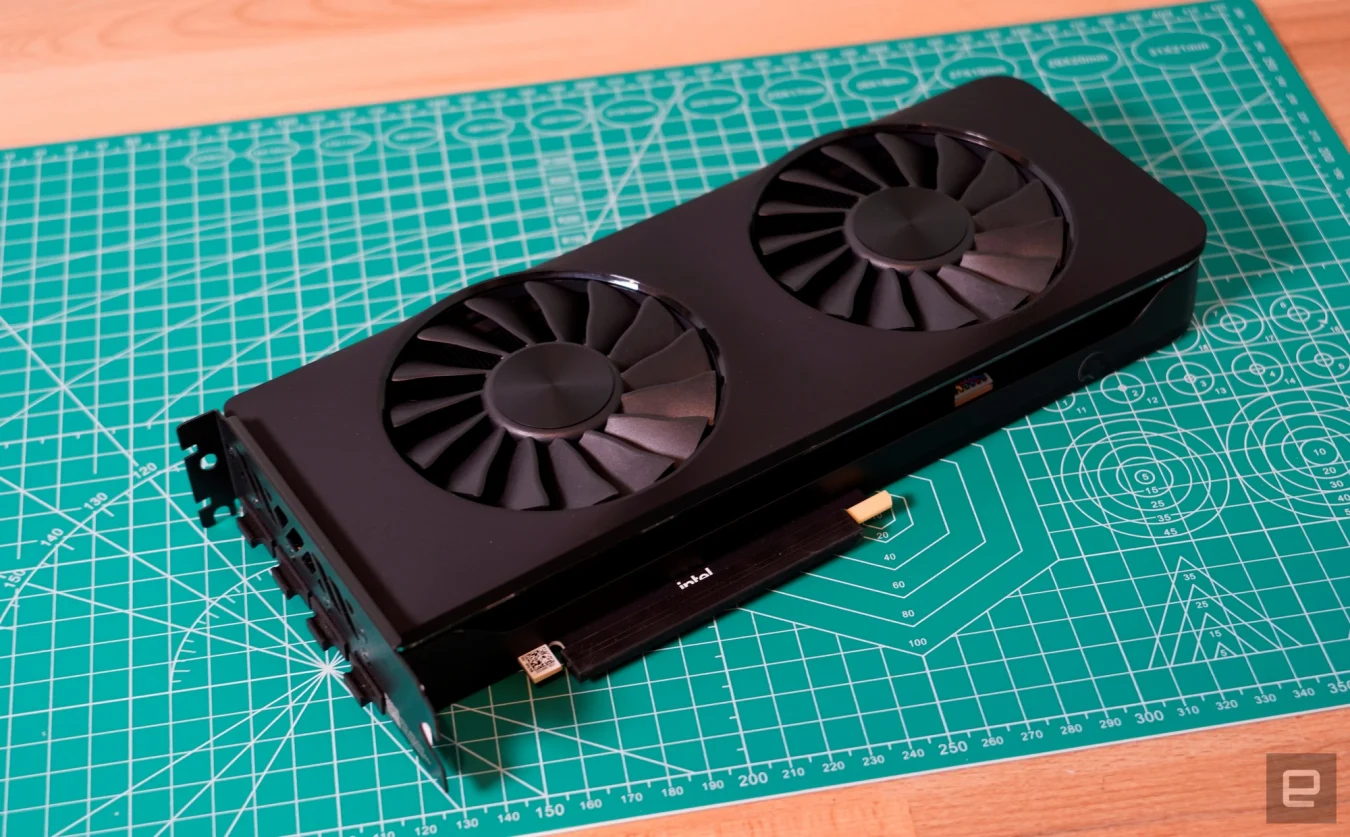




 Pros
Pros